Provisioning
Business Configuration and Product Catalogue
Via the Business Configuration A module in the CMP Administation console that provides for viewing and modification of business and user applicable system configuration. module of the Administration Console An operations web console that allows batch jobs to be scheduled, run manually and monitored. The console also provides for viewing and modification of business and user applicable system configuration., CMP Converged Monetisation Platform. The MDS Global product that supports customer care and billing for digital service providers. supports configuration of an Integrated Product Catalogue The CMP component that details the products and services available to subscribers., which details the products and services available to subscribers. The catalogue is flexible, typically holding airtime propositions comprising tariffs, price plans, bolt-ons, discounts, services and features.
Items can be configured as Subscription A billing entity that incurs a charge. Examples include a network attached device whose usage you want to measure and charge for, or a monthly software subscription Related, meaning if chosen the item requires a new subscription to be created or an existing subscription to be selected.
Items can be added to the Product Catalogue, individually or as a Price Plan. A Price Plan relates multiple Items together, for example an offer that includes airtime, texts, data and handset A mobile phone insurance. When a Price Plan is selected, all Items are automatically selected when the order is placed.
Products can be configured with minimum, maximum and default price, allowing the CMP user A person with the capability to log in to the CMP GUI software, such as a customer service advisor or agent. to stipulate the price when placing a customer In the context of the Cloud Monetisation Platform, an individual or organisation who has signed an agreement to take goods and services from a service provider. A customer receives a bill associated with one or more subscriptions, and can be a single end user or a large company with many subscriptions assigned to one agreement. order. The manipulation of pricing is commonly used in business and corporate implementations where prices can be negotiated. CMP security level functionality controls which level of users have the ability to amend pricing.
For more information, see the Business Configuration Overview.
The Product Catalogue accepts queries from third party Of software; a reusable component developed to be either freely distributed or sold by an entity other than the original vendor of the development platform. portals to filter bolt-ons and Value added services (VAS value-added service. In mobile telecommunications, services other than the core services of standard voice transmissions, data, and text mesages, for example voicemail, online game, or stickers.) according to the customers chosen Price Plan.
Number Management
Subscriptions are identified by Serial Numbers. These are unique identifiers against which records stored in CMP if Number Management functionality is used by the service provider The owner of the infrastructure in which accounts will be created. The Service Provider can host and operate the instance of CMP, or CMP can be provided as a Managed Service..
Serial Numbers can be stored in text, numeric or alphanumeric format allowing information such as unique numbers, IDs, usernames or email addresses to be stored.
Serial Numbers are configured as per individual service provider requirements.
CMP has two types of Serial Numbers:
Managed Serial Numbers
CMP can store up to five Managed Serial Numbers against a subscription. CMP Number Management controls the numbers that are available for selection for each Managed Serial Number. Typical examples of Managed Serial Numbers include Mobile Phone Number, SIM Subscriber Identity Module. A smart card (electronic chip) inside a mobile phone that communicates with the network and carries an identification number unique to the owner. The SIM can also store personal data. Number, IMSI International Mobile Subscriber Identity. A unique number, usually fifteen digits, identifying a GSM subscriber., IMEI International Mobile Equipment Identity. A unique 14-digit number assigned to every GSM mobile phone, which includes information on the origin, model, and serial number of the mobile device. The IMEI number is used by networks to identify valid phones and block stolen or blacklisted phones from accessing the network. Number, and Selfcare A MDS online self-service customer care tool. ID.
Non-Managed Serial Numbers
Managed and Non-Managed Serial Numbers are assigned when creating subscriptions and can be maintained in life via AgentView The graphical user interface of the CMP that is typically used by Customer Service Agents to access CMP customer and billing data. In versions prior to CMP 8.0, this was called the CMP GUI. and web services.
During the life of a subscription, a mobile phone number can change, for example when porting The process of transferring a subscriber between service provider networks while ensuring they retain their existing mobile telephone number. in or changing a number due to nuisance calls.
SIM Profile Loader
A SIM profile - or SIM card - is an integrated circuit that is intended to securely store International Mobile Subscriber Identity (IMSI) details, which are used to identify and authenticate subscriptions on mobile telephony devices such as mobile phones or laptops. The SIM card itself has its own unique reference known as an Integrated Circuit Card Identifier (ICCID Integrated Circuit Card Identifier, or ICCID, is a globally unique serial number used to identify a SIM card in a mobile device. It is used to identify both a physical SIM card and an eSIM profile, and is typically found on the device's settings.), which cannot be changed. CMP allows for a primary and secondary profile to be stored for a given ICCID.
CMP automatically loads files of SIM profiles that are received for use in allocation to subscribers and resolving agent queries, for example a customer contacting the call centre to request a Personal Unlocking Key (PUK) code to unlock their phone.
Lifecycle Management
Mobile phone numbers that have been disconnected or are no longer used (due to a number change for example) are managed by Lifecycle Management.
Number Management can handle any type of number but is typically used for mobile numbers.
Phone numbers remain in Lifecycle Management for a pre-determined number of days known as the Cooling Off Period Period of time after an upgrade during which a customer can revert back to their original plan without incurring a penalty.. Once these days have passed, the number can be reused by another Subscription.
Numbers not owned by/allocated by the Service Provider are removed from CMP. This includes numbers which have been ported out. In these scenarios numbers cannot be recycled.
Network Provisioning
CMP handles provisioning In telecommunications, the setup of equipment, wiring and transmission to deliver services to a customer. requirements such as subscription activation, deactivation, suspension, un-suspension, and services Activation using the Network In the context of CMP, the infrastructure on which usage of registered customers will be measured – this could be a mobile phone network, broadband network or other non-telecommunications network. Interface Framework (NIF Network Interface Framework. An object-oriented software architecture for providing networking services.) to interact with a third party provisioning system.
The Network Interface Framework is driven by a Workflow Event configured with the appropriate Workflow Event Actions. Each Action has one Action Item associated with it. An Action and Action Item must be contained within a Workflow Event to create a provisioning request.
Actioned Items can be viewed, monitored and maintained in the Action Items screen in AgentView.
_627x192.png)
CMP Network Interface Framework (NIF)
Network Provisioning Process
The Action Item Poller periodically searches for new Actioned Items that identify commands waiting to be sent to the network. Details of the commands are written to the Network Requests Log.
The Network Request Log Poller searches for commands awaiting processing in the Network Request Log. These commands are handed over to Command Handling routines which read appropriate information from the CMP Subscription database files, transforming those details into a suitable format which are then sent to the network.
Where an interface is synchronous In telecommunication networks, signals within a network or between networks that occur at the same clock rate when all clocks are based on a single reference clock., CMP sends the request and handles the response. Where the request is asynchronous In telecommunications, transmission of data without the use of an external clock signal, where data is transmitted intermittently rather than in a steady stream., CMP may make periodic calls to the network to check the status of the request. The response is processed according to business rules specific to the network.
The status of the actioned item is then updated to reflect the outcome of the request. The Notes of the associated Workflow Event are also updated, capturing Network specific details.
Successful requests lead to the Subscription being updated to reflect the changed state. In the event of an error, the associated Workflow Event will be moved into an error status and passed to an appropriate Worklist for review.
Generic Provisioning Interface
The CMP Generic Provisioning interface is alternative functionality to the standard CMP provisioning process when network integration is required. The CMP Generic Provisioning interface provides a message queue-based interface, allowing a Service Provider or systems integrator to handle the integration between the CMP interface and the network:
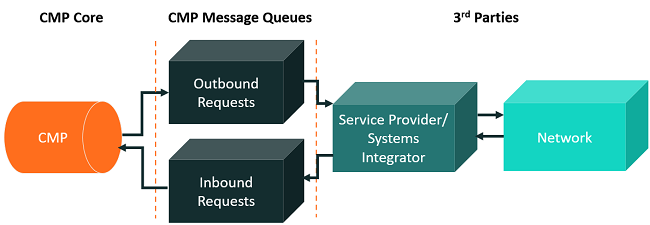
CMP Provisioning Interface
Generic Provisioning uses Workflow Events Manually or automatically created task items that drive and record activity within CMP. Sometimes referred to as Diary Events. and the existing CMP Network Interface Framework (NIF) to generate provisioning requests and places the requests on the outbound message queue instead of talking directly to the network.
The Service Provider or systems integrator monitors the message queue and translates the generic request messages to the format required by the network before sending the request to the network.
The network returns a response to the Service Provider or systems integrator, who translates the network response into the generic format expected by CMP Generic Provisioning and places the response on the inbound message queue, where it is picked up by CMP and processed appropriately.
Errors are output in the same way standard provisioning requests are made if encountered.
Network Porting Processing
CMP, in the UK, interfaces with Syniverse The Mobile Number Portability platform used by UK MNOs and MVNOs to initiate the porting process. to fulfil the regulatory porting scenarios required by OFCOM including creation and management of Porting Authorisation Codes (PACs) codes to support porting in and out of the service provider's network.
CMP supports both donor and recipient led port processes.
As part of the port-out process, CMP holds details of the PAC The Porting Authorisation Code, or PAC, is supplied by Syniverse (UK only) when subscribers choose to keep their mobile number when moving to another operator. The subscriber provides this code to the new network provider to initiate the process of porting their phone number. and the PAC expiry date.
CMP uses Workflow Event Actions to automatically send a disconnection request to the donor network to disconnect a subscriber The end user of a network..
As part of the port-in process, CMP retains details of the:
- customer
- Mobile Station International Subscriber Directory Number (MSISDN Mobile Station International Subscriber Directory Number, often referred to as a Mobile Number. A number uniquely identifying a subscription in a mobile network.) being ported
- porting (donor) network
- PAC
- port-in date
CMP uses Workflow Event Actions to automatically send a provisioning request to the recipient network to connect the Subscriber.
Port Out - donor led example
- CMP generates PAC codes and registers them with the Mobile Number Portability (MNP Mobile Number Portability. An implementation or standard that enables mobile phone users to retain their phone number when transferring from one mobile network operator to another.) platform.
- On the appropriate days of the week, CMP retrieves the port outs for the next port date and schedules the port out To ensure a customer transfers out of a service provider's network and retains their existing mobile phone number. requests.
Port outs take place Monday to Fridays, not including public holidays.
Port In - donor led example
- CMP accepts Porting Authorisation Code (PAC) and Port Mobile Station International Subscriber Directory Number (MSISDN) details either through its GUI Graphical User Interface.
A user interface that allows users to interact with electronic devices through graphical icons and visual indicators. In the context of CMP, the CMP GUI is the user interface typically used by CSAs to access customer data stored in CMP. or via the web service XML- or JSON-based information exchange systems that use the Internet for direct application-to-application interaction. These systems can include programs, objects, messages, or documents. interface.
- Through both channels, CMP interacts with the Mobile Number Portability (MNP) platform to close the PAC and confirm the port date.
- On the appropriate days of the week, CMP retrieves the port ins for the next port date and schedules the port in To add a subscriber to a service provider's network while ensuring they retain their existing mobile phone number. requests in line with network requirements.
Generic Porting Interface
The CMP Generic Porting interface is alternative functionality, to the standard CMP porting process, when recipient-led porting is required inside and outside of the UK.
The CMP Generic Porting interface is a message queue-based interface that allows a Service Provider or systems integrator to perform the integration between CMP and country-specific porting interfaces. The Generic Porting interface is based on the same message queue framework as Generic Provisioning.
The Generic Porting interface supports:
- Port In
- Port Out
- Cancel Port In
- Reverse Port In/Out
Requests and responses are placed on a message queue and are picked up appropriately by CMP or the Service Provider or systems integrator depending on the porting scenario. For example, port in requests are initiated in CMP and port out requests are initiated by the Service Provider:
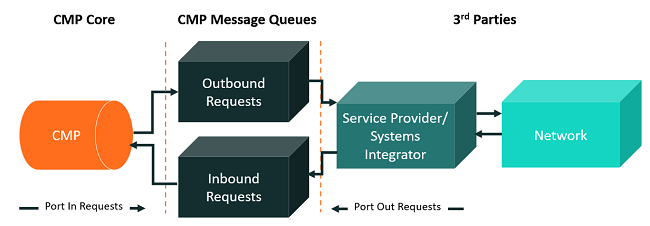
CMP Porting Interface
Generic Porting interface configuration can be tailored to meet specific business requirement and porting processes.
It is the responsibility of the Service Provider or systems integrator to handle the translation of CMP generic messages to and from the format required by the third party network or country-specific porting interfaces.